IMO MSC.581(110): Why Your 4-Gas Detector Is No Longer Enough.
MSC.581(110).
A regulation change that took effect on 3 December 2025 has fundamentally altered the requirements for enclosed space entry aboard ships. IMO Resolution MSC.581(110) replaces Resolution A.1050(27) and introduces mandatory CO2 monitoring as a core atmospheric testing requirement before any enclosed space entry. For safety managers and fleet operators, this means one thing: a standard portable 4-gas detector may no longer be sufficient.
CO2 is now a primary hazard.
Under the previous regulation A.1050(27), CO2 was not a specific entry parameter. Many fleets relied on 4-gas detectors measuring O2, LEL, CO and H2S without any CO2 capability. MSC.581(110) closes that gap.
The new atmospheric limits require oxygen levels of at least 20.9%, CO2 concentrations below 0.5% by volume (5,000 ppm), carbon monoxide within occupational exposure limits, and flammable gases below 1% of the lower explosion limit.
The reason CO2 was added is straightforward. CO2 can reach dangerous concentrations without affecting oxygen levels, making it a silent hazard. It is now mandatory to measure CO2 separately and comply with the 0.5% threshold before entering any enclosed space.
Who is affected.
MSC.581(110) requires at least two sets of portable gas detection equipment per vessel. For ships carrying high-risk cargoes such as coal, wood pellets or metal sulfide concentrates, at least four sets are required.
Port State Control surveyors are now instructed to verify the presence of CO2-capable detectors during inspections, and the absence of such equipment will be noted.
Our recommendations.
Three MSC.581(110)-compliant 5-gas detectors, selected for maritime enclosed space entry. All available through Lavastica. Contact us directly to get the fastest results.

GasAlertMicro 5
Monitors O2, LEL, CO, H2S and CO2 simultaneously. The optional motorised pump allows pre-entry sampling of cargo holds before personnel enter, making it suitable for both space clearance and continuous personal monitoring.

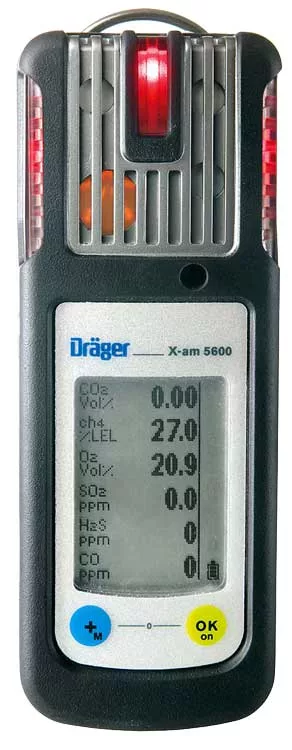
X-AM 5600
A configurable 1 to 5-gas detector with interchangeable sensors. CO2 monitoring can be added or reconfigured across instruments, making fleet-wide compliance straightforward without replacing every unit.

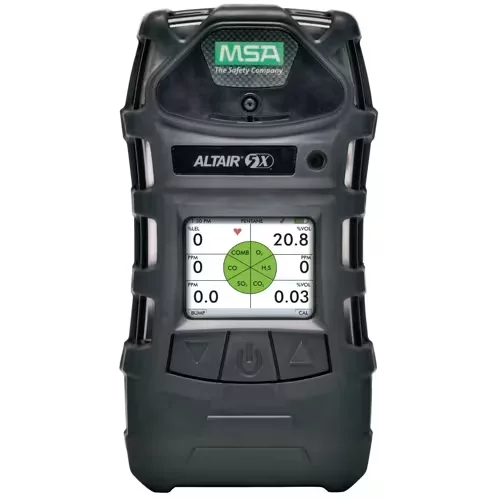
ALTAIR 5X
A wearable detector built for continuous personal monitoring during enclosed space entry. The NDIR infrared CO2 sensor operates independently of ambient oxygen levels, reliable in the conditions MSC.581(110) is designed to address.
Contact us.
Please send us an email or call us to see how we can help you regarding protable 5-gas detectors.
FAQ.
Is my current 4-gas detector still compliant under MSC.581(110)?
Not for full compliance. MSC.581(110) requires atmospheric testing for five gases: O2, LEL, CO, H2S and CO2. A traditional 4-gas detector typically covers the first four but lacks a CO2 sensor. Simply adding CO2 to a 4-gas instrument is not always possible without dropping another gas. A dedicated 5-gas detector is the most practical and future-proof solution.
When did MSC.581(110) come into force?
The regulation came into force on 3 December 2025 and applies to all ship types globally. The final implementation deadline for full fleet compliance is 2027. We recommend verifying the exact requirements for your vessel type and flag state with a qualified maritime authority or legal advisor.
Do I need to update my calibration gas as well?
Yes. Calibration routines and bump test gas must include CO2. Existing calibration kits that do not contain CO2 will need to be updated alongside any detector upgrade.
How many detectors does my vessel need?
A minimum of two sets of portable gas detection equipment is required under SOLAS XI-1/7. Vessels carrying high-risk cargoes must carry at least four sets.
Can a single instrument handle both pre-entry space clearance and personal monitoring?
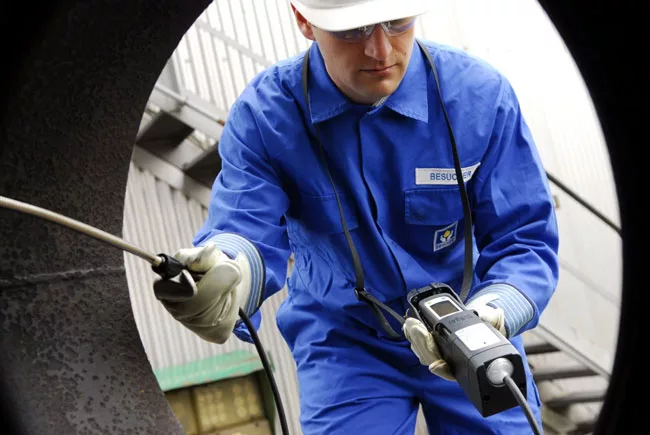
Some instruments, such as the GasAlertMicro 5 with pump option and the Drager X-AM 5000 with external pump, support both functions. For vessels requiring separate pre-entry clearance and continuous personal monitoring, two instrument types may be more practical.

Always verify compliance requirements with your flag state authority or a certified maritime inspector. This page is intended as a technical guide only.